
Cerinta completa
Consider an undirected graph where each edge weighs 6 units. Each of the nodes is labeled consecutively from 1 to n.
You will be given a number of queries. For each query, you will be given a list of edges describing an undirected graph. After you create a representation of the graph, you must determine and report the shortest distance to each of the other nodes from a given starting position using the breadth-first search algorithm (BFS). Return an array of distances from the start node in node number order. If a node is unreachable, return for that node.
Example
The following graph is based on the listed inputs:
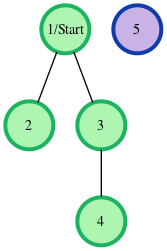
// number of nodes
// number of edges
// starting node
All distances are from the start node . Outputs are calculated for distances to nodes through : . Each edge is units, and the unreachable node has the required return distance of .
Function Description
Complete the bfs function in the editor below. If a node is unreachable, its distance is .
bfs has the following parameter(s):
- int n: the number of nodes
- int m: the number of edges
- int edges[m][2]: start and end nodes for edges
- int s: the node to start traversals from
Returns
int[n-1]: the distances to nodes in increasing node number order, not including the start node (-1 if a node is not reachable)
Input Format
The first line contains an integer , the number of queries.
Each of the following sets of lines has the following format:
- The first line contains two space-separated integers and , the number of nodes and edges in the graph.
- Each line of the subsequent lines contains two space-separated integers, and , that describe an edge between nodes and .
- The last line contains a single integer, , the node number to start from.
Constraints
Sample Input
2
4 2
1 2
1 3
1
3 1
2 3
2
Sample Output
6 6 -1
-1 6
Explanation
We perform the following two queries:
-
The given graph can be represented as:
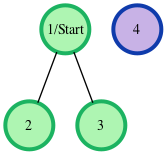
where our start node, , is node . The shortest distances from to the other nodes are one edge to node , one edge to node , and an infinite distance to node (which it is not connected to). We then return an array of distances from node to nodes , , and (respectively): . -
The given graph can be represented as:
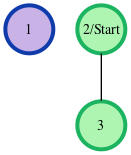
where our start node, , is node . There is only one edge here, so node is unreachable from node and node has one edge connecting it to node . We then return an array of distances from node to nodes , and (respectively): .
Note: Recall that the actual length of each edge is , and we return as the distance to any node that is unreachable from .
Limbajul de programare folosit: java8
Cod:
import java.io.*;
import java.util.*;
import java.text.*;
import java.math.*;
import java.util.regex.*;

public class Solution {
    public static ArrayList<Integer> bfs(ArrayList<ArrayList<Integer>> adj, int s) {
        LinkedList<Integer> q = new LinkedList<Integer>();
        ArrayList<Integer> result = new ArrayList<Integer>(adj.size());
        for (int i = 0; i < adj.size(); i++) {
            result.add(0);
        }
        q.addFirst(s);

        while (q.size() > 0) {
            int current = q.pollLast();
            ArrayList<Integer> tmp = adj.get(current);
            for (int i = 0; i < tmp.size(); i++) {
                int v = tmp.get(i);
                if (result.get(v) == 0) {
                    q.addFirst(v);
                    result.set(v, result.get(current) + 6);
                }
            }
        }

        return result;
    }

    public static void main(String[] args) {
        Scanner in = new Scanner(System.in);
        int q = in.nextInt();
        for(int a0 = 0; a0 < q; a0++){

            int n = in.nextInt();
            ArrayList<ArrayList<Integer>> adj = new ArrayList<ArrayList<Integer>>(n);
            for (int i = 0; i < n; i++) {
                adj.add(new ArrayList<Integer>());
            }

            int m = in.nextInt();
            for(int a1 = 0; a1 < m; a1++){
                int u = in.nextInt() - 1;
                int v = in.nextInt() - 1;
                // First
                ArrayList<Integer> tmp = adj.get(u);
                tmp.add(v);
                adj.set(u, tmp);

                // Second
                tmp = adj.get(v);
                tmp.add(u);
                adj.set(v, tmp);
            }

            int s = in.nextInt() - 1;

            ArrayList<Integer> result = Solution.bfs(adj, s);

            for (int i = 0; i < n; i++) {
                if (i != s) {
                    if (result.get(i) == 0) {
                        System.out.print("-1 ");
                    } else {
                        System.out.print(result.get(i) + " ");
                    }
                }
            }
            System.out.print("\n");
        }
        in.close();
    }
}
Scor obtinut: 1.0
Submission ID: 464604233
Link challenge: https://www.hackerrank.com/challenges/bfsshortreach/problem