
Challenge: Constructing a Number
Subdomeniu: Number Theory (number-theory)
Scor cont: 15.0 / 15
Submission status: Accepted
Submission score: 1.0
Submission ID: 464720023
Limbaj: python3
Link challenge: https://www.hackerrank.com/challenges/constructing-a-number/problem
Cerinta
Manipulating numbers is at the core of a programmer's job. To test how well you know their properties, you are asked to solve the following problem.
You are given $n$ non-negative integers $a_1$, $a_2$, ..., $a_n$. You want to know whether it's possible to construct a new integer using all the digits of these numbers such that it would be divisible by $3$. You can reorder the digits as you want. The resulting number can contain leading zeros.
For example, consider the numbers $50, 40, 90$ from which you have to construct a new integer as described above. Numerous arrangements of digits are possible; but we have illustrated one below.
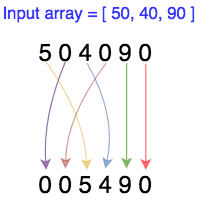
Complete the function `canConstruct` which takes an integer array as input and return "`Yes`" or "`No`" based on whether or not the required integer can be formed.Input Format
The first line contains a single integer $t$ denoting the number of queries. The following lines describe the queries.

Each query is described in two lines. The first of these lines contains a single integer $n$. The second contains $n$ space-separated integers $a_1$, $a_2$, ..., $a_n$.
Output Format
For each query, print a single line containing "`Yes`" if it's possible to construct such integer and "`No`" otherwise.Constraints
- $1 \leq t \leq 100$
- $1 \leq n \leq 100$
- $1 \leq a_i \leq 10^9$

**Subtasks**

For 33.33% of the total score:

- $n = 1$
- $1 \leq a_1 \leq 10 ^ 6$
Cod sursa
#!/bin/python3

import math
import os
import random
import re
import sys

def canConstruct(a):
    if sum(a) % 3 == 0:
        return 'Yes'
    else:
        return 'No'
if __name__ == '__main__':
    fptr = open(os.environ['OUTPUT_PATH'], 'w')

    t = int(input().strip())

    for t_itr in range(t):
        n = int(input().strip())

        a = list(map(int, input().rstrip().split()))

        result = canConstruct(a)

        fptr.write(result + '\n')

    fptr.close()
HackerRank Number Theory – Constructing a Number